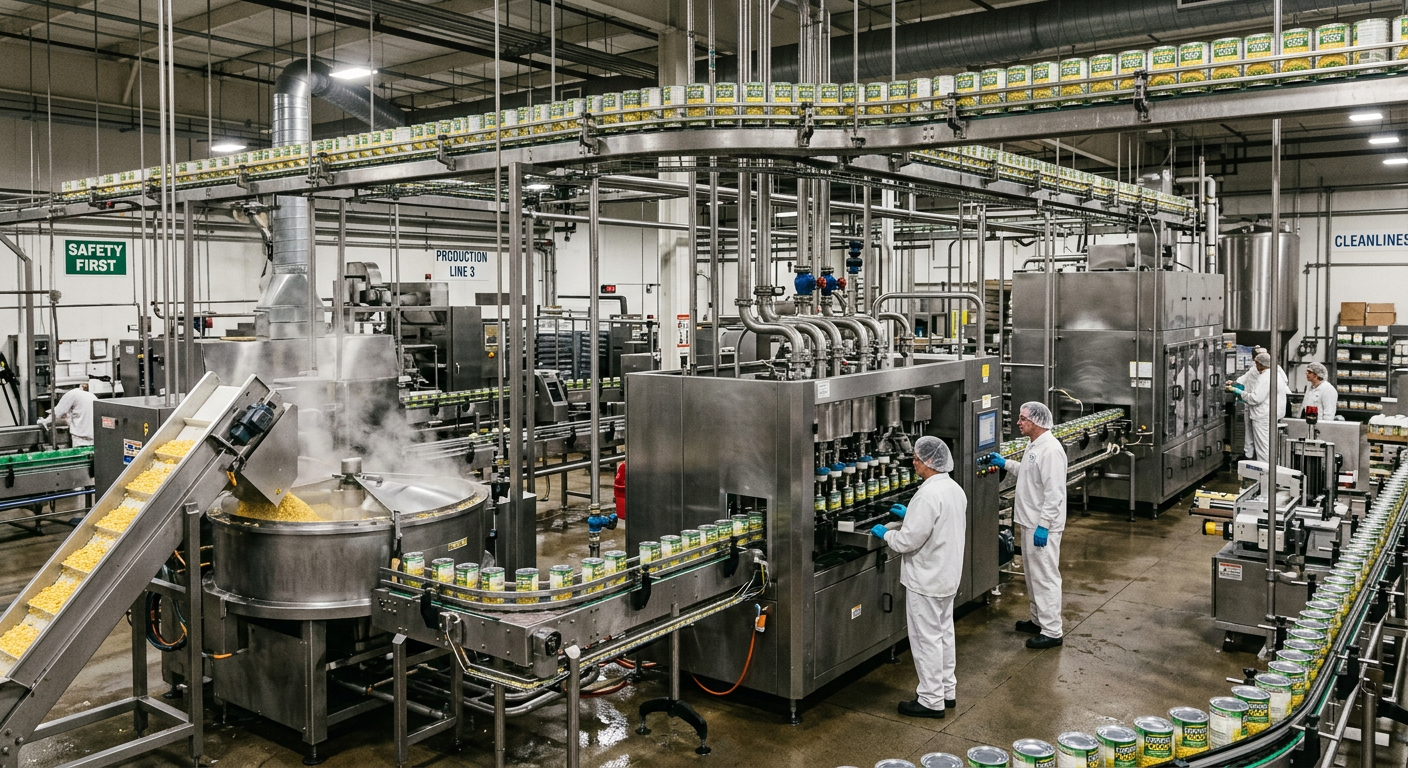
Clean in place — universally abbreviated as CIP — is the automated internal cleaning of process equipment without disassembly. It is, moreover, the backbone of hygienic manufacturing across food processing, dairy, brewing, beverage, pharmaceutical, and personal care production. For plant managers and chemical formulators alike, understanding CIP chemistry at a process level is the difference between a reliable cleaning program and one that erodes equipment, wastes chemistry, and fails microbial validations.
This guide covers how clean in place systems are structured, what happens chemically at each stage, and how additive selection determines whether a CIP program performs to specification.
What Is Clean in Place?
A clean in place system circulates cleaning and sanitizing solutions through closed process circuits at controlled concentrations, temperatures, flow velocities, and contact times. The objective is straightforward: remove process soils, eliminate microbial contamination, and restore equipment to a validated hygienic condition — all without requiring physical access or disassembly.
The fundamental principle is described by the Sinner Circle. Cleaning effectiveness is a function of four variables: chemical action, thermal energy, mechanical action (flow), and time. CIP programs balance these four factors based on soil type, equipment geometry, and regulatory requirements. Therefore, altering one factor — such as reducing temperature to save energy — demands compensating increases in the others, typically chemistry concentration or contact time.
For equipment to qualify as CIP-able, it must meet hygienic design standards that ensure full internal wetability. 3-A Sanitary Standards and EHEDG guidelines define surface finish requirements, minimum pipe slopes, and acceptable fitting geometries for food and pharmaceutical CIP applications.
Clean in Place System Architecture
Most industrial CIP installations share a common architecture. However, configuration varies significantly by scale and application.
Single-use vs. recovery systems
Single-use CIP passes cleaning solutions to drain after one circuit. It is simple to validate and eliminates cross-contamination risk between allergen or flavor changeovers. However, chemical and water costs are high. It is most common in pharmaceutical manufacturing and in food facilities with strict allergen segregation requirements.
Recovery CIP, on the other hand, returns used caustic and acid solutions to holding tanks for reuse across multiple cycles. This is the dominant configuration in dairy, brewery, and large-scale food processing. It requires conductivity monitoring, automated chemical dosing, and regular soil load assessment to maintain bath integrity.
Multi-tank CIP skids typically include a water tank, caustic tank, acid tank, and sanitizer tank, along with a return tank for recovered solutions. Single-tank portable CIP units are used for smaller circuits where full automation is not justified.
Flow velocity requirements
Turbulent flow — a Reynolds number above 10,000, which corresponds to approximately 5 ft/s (1.5 m/s) in standard sanitary tubing — is the minimum threshold for mechanical cleaning action in CIP pipelines. Heat exchangers, vessel walls, and spray devices each have different requirements. Under-designed CIP systems that achieve only laminar flow produce inconsistent cleaning results regardless of chemical strength.
The CIP Cleaning Process: Five Phases
A standard CIP cleaning process runs through five sequential phases.
Phase 1 — Pre-rinse. A water flush removes bulk soil and prevents it from being driven into the chemistry circuit. Warm water at 100–120°F (38–49°C) is preferred because it softens protein and fat deposits. In addition, pre-rinse quality directly affects how quickly the caustic phase reaches working concentration.
Phase 2 — Caustic wash. Sodium hydroxide solution at 0.5–2.0% concentration is circulated at 160–180°F (71–82°C) for 20–45 minutes. Caustic hydrolyzes proteins, saponifies fats, and disperses carbohydrates. In dairy and brewery applications, mineral scale — milkstone and beerstone — requires specific additive support to prevent re-deposition on equipment surfaces.
Phase 3 — Intermediate rinse. Fresh or recovered water removes caustic residue before the acid phase. Conductivity or pH monitoring confirms sufficient displacement before proceeding.
Phase 4 — Acid wash. Nitric acid, phosphoric acid, or organic acid blends at 0.5–1.5% concentration remove the mineral scale that caustic cannot dissolve. In dairy applications, this phase addresses milkstone — calcium phosphate complexed with protein. In brewery applications, it targets tartrate and oxalate deposits. Acid wash frequency depends on water hardness and soil mineral content.
Phase 5 — Sanitization. Peracetic acid (PAA), sodium hypochlorite, chlorine dioxide, or hydrogen peroxide is applied at low concentrations to achieve a sanitized surface before production restart. Some facilities use hot water sanitization instead of chemical sanitizers, depending on regulatory context.
Where CIP Chemistry Fails — and Why Additives Matter
The raw chemicals used in CIP — sodium hydroxide, nitric acid, sodium hypochlorite — are each effective at their individual tasks. Nevertheless, the failure modes in industrial CIP programs almost never stem from inadequate caustic strength. Instead, they stem from what happens to the caustic, the oxidizer, and the soils in the presence of hard water, complex protein matrices, and equipment dead legs.
Hard water interference in caustic circuits
Hard water — water with elevated calcium and magnesium ion concentrations — reacts with sodium hydroxide to form insoluble precipitates. Consequently, these precipitates deposit on heat exchanger surfaces, spray nozzles, and vessel walls. This creates insulating scale that degrades thermal transfer efficiency and provides harborage for biofilm. In recovery CIP systems, the cumulative effect on bath quality is severe.
Caustic CIP additives — specifically low-foam surfactant and chelant blends formulated for stability in 50% NaOH solutions — address this directly. A properly formulated caustic additive maintains calcium and magnesium ions in suspension rather than allowing them to precipitate. It also preserves wetting action on hydrophobic soil films and controls foam in spray-ball and high-turbulence environments. AlkaBoost™ is engineered specifically for this application: NaOH-soluble, low-foam, and stable at CIP operating temperatures up to 185°F (85°C).
Foam in recirculating CIP systems
Excessive foam in CIP return lines is not merely an operational nuisance. Furthermore, it reduces effective pump flow, creates air pockets in spray devices, and produces inconsistent soil contact times. Foam is generated by protein-laden pre-rinse carryover, surfactant overdosing, and high turbulence at return pumps. Therefore, selecting a surfactant with a validated low-foam profile at CIP temperatures and concentrations is a prerequisite — not an optional specification. See our Food Processing CIP Solutions guide for foam control benchmarks by application type.
Oxidizer instability in sanitizer circuits
Sodium hypochlorite, peracetic acid, and hydrogen peroxide are oxidizing agents that degrade many conventional surfactants rapidly. This is the central formulation challenge in oxidizer-based CIP cleaners and sanitizer-surfactant combinations. Most nonionic surfactants are incompatible with oxidizers at CIP concentrations and contact times. The result is either premature surfactant breakdown — producing malodorous byproducts and losing wetting efficacy — or aggressive foaming that destabilizes the sanitizer circuit.
Oxidizer-stable, low-foam surfactants resolve this by maintaining chemical compatibility with NaOCl, PAA, H₂O₂, and ClO₂ across the full concentration and temperature range of sanitation applications. OxiVantage LF™ is formulated for exactly this application — stable in bleach-based and peroxide-based systems, with a verified low-foam profile for both CIP recirculation and spray applications.
CIP in Food Processing Applications
The soil profile in food processing CIP varies significantly by product type. As a result, it must drive chemistry selection for every application.
Dairy processing generates soils dominated by whey protein complexes, butterfat, and calcium phosphate mineral films (milkstone). Caustic wash performance is strongly influenced by water hardness and by the temperature history of the product. Specifically, pasteurized and UHT product residues are substantially harder to remove than raw product films. See our Caustic Soda CIP Guide for dairy-specific concentration and temperature recommendations.
Brewery and craft beverage applications involve hop resin, yeast, protein precipitates, and beerstone — a calcium oxalate-protein matrix that is characteristically resistant to standard caustic washes. Consequently, brewery CIP programs require higher caustic concentrations, extended contact times, and periodic acid wash cycles with surfactant support. Refer to our Brewery CIP Surfactants page for a full breakdown of beerstone chemistry and prevention strategies.
Meat and poultry processing produces high-fat, high-protein soils that demand elevated caustic temperatures and robust emulsification chemistry. Foam control is particularly critical in these facilities due to the high fat load in pre-rinse return water.
Prepared foods and snack manufacturing often involve starch and sugar soils that respond well to caustic. However, they can cause significant foam in high-turbulence CIP circuits without low-foam additive support.
For additional context on CIP system design by industry, the Oklahoma State University Extension CIP fact sheetprovides a useful academic reference.
Selecting CIP Chemistry: A Formulator’s Framework
For distributors, private-label formulators, and plant chemists building or specifying CIP programs, the selection framework involves four decisions.
1. Characterize the soil. Protein, fat, carbohydrate, and mineral soil types respond to different chemical mechanisms. Therefore, a site audit or soil analysis should precede chemistry specification — particularly for complex multi-product facilities.
2. Define the water chemistry. Hardness, alkalinity, and conductivity of the incoming water supply determine the chelant and sequestrant requirements of the caustic circuit. Facilities on hard municipal water or well water require more robust additive packages than those using softened or RO-treated process water.
3. Match the surfactant to the circuit type. Caustic circuits require surfactants with NaOH solubility and thermal stability. Oxidizer circuits require surfactants with demonstrated compatibility with the specific oxidizing agent at operating concentration and temperature. Using a general-purpose surfactant in either application is a formulation failure mode.
4. Validate against HACCP and regulatory requirements. Food contact CIP chemicals must comply with applicable regulations — specifically 21 CFR 178.1010 for sanitizers and applicable GRAS designations for rinse-safe formulation components. Pharmaceutical and personal care CIP programs operate under additional validation requirements under GMP frameworks. The USDA FSIS HACCP guidelines provide a useful compliance reference.
IG Chemical Solutions supplies both caustic CIP additive and oxidizer-stable surfactant actives to formulators and distributors. Contact our technical team to discuss custom concentrations, private-label packaging, and compatibility data for your specific process chemistry.
CIP Optimization: Reducing Chemical Use Without Compromising Efficacy
CIP programs in food and beverage manufacturing are a significant operating cost. Chemistry, water, energy, and downtime together account for a meaningful share of total facility operating expense. Therefore, optimization programs that reduce CIP cycle frequency, shorten cycle time, or extend bath life without compromising cleaning efficacy are a consistent priority for plant engineers.
Additive selection is one of the highest-leverage optimization variables. A well-formulated caustic additive that controls hard water deposition extends bath life in recovery CIP systems. This, in turn, reduces the frequency of bath dumps and replenishment. A low-foam surfactant eliminates foam-related cycle extensions and reduces the post-wash rinse volume required to achieve conductivity targets. In aggregate, these effects meaningfully reduce per-cycle chemistry costs.
Key monitoring parameters that indicate CIP performance include turbidity of the pre-rinse return, caustic bath conductivity and soil load, and post-CIP ATP or protein swab results. These data points provide the information needed to tighten cycle parameters and identify circuit-specific problem areas before they escalate into product safety events.
Frequently Asked Questions
Clean in place (CIP) is the automated internal cleaning of process equipment without disassembly. Cleaning solutions circulate through closed circuits — including piping, vessels, and heat exchangers — at controlled concentrations, temperatures, flow rates, and contact times.
CIP cleaning typically uses sodium hydroxide (caustic) for protein and fat removal, nitric or phosphoric acid for mineral scale, and an oxidizing sanitizer such as sodium hypochlorite, peracetic acid, or hydrogen peroxide. Surfactant additives are added to improve wetting, control foam, and prevent hard water deposition.
A standard CIP cleaning process follows five steps: (1) pre-rinse to remove bulk soil, (2) caustic wash to dissolve protein and fat, (3) intermediate rinse to remove caustic residue, (4) acid wash to remove mineral scale, and (5) sanitization with an oxidizing agent.
CIP optimization typically involves selecting surfactant additives matched to your soil type and water chemistry, extending bath life in recovery CIP systems through hard water control, and monitoring conductivity and ATP results to tighten cycle parameters over time.
Summary
Clean in place is not a commodity process. The cleaning chemistry, additive selection, and system design that underpin a CIP program directly determine its reliability, cost of operation, and compliance profile. Formulators and plant managers who understand the chemistry — and who specify additives matched to their specific soil type, water chemistry, and circuit conditions — operate CIP programs that perform consistently and cost less to run.
IG Chemical Solutions manufactures CIP additive chemistry for both caustic and oxidizer circuits:
- AlkaBoost™ — Low-foam caustic CIP additive, NaOH-soluble and hard water stable, for food processing, dairy, brewery, and pharmaceutical CIP circuits.
- OxiVantage LF™ — Oxidizer-stable low-foam surfactant for NaOCl, PAA, H₂O₂, and ClO₂ CIP and sanitizer applications.
Distributors and formulators: contact us to request technical data sheets, compatibility test data, and private-label specifications.
Further reading and references: